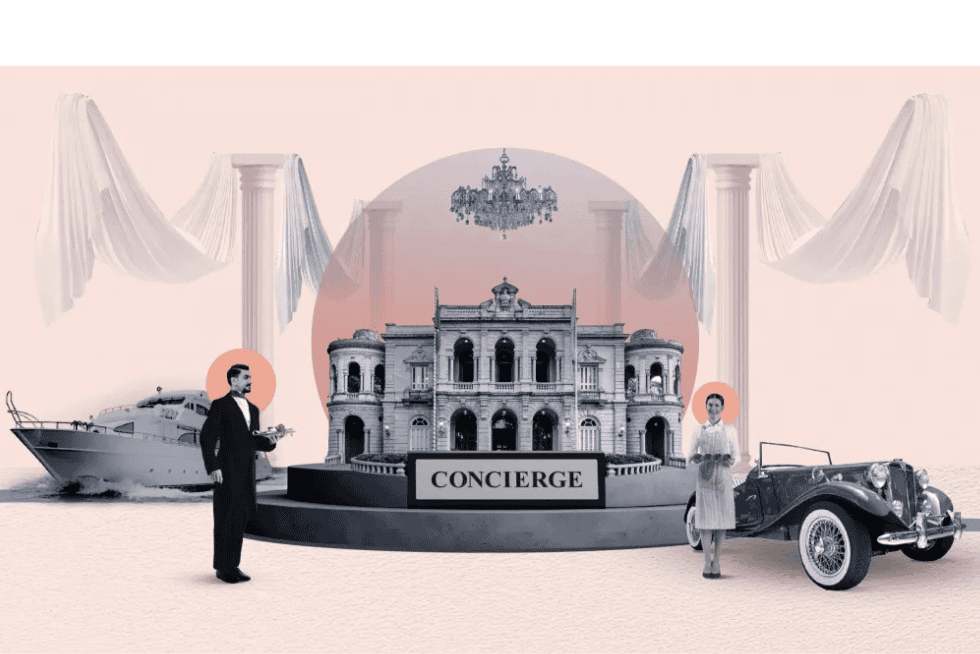
How a role built on trust and access evolved over 600 years into one of today’s most valuable tools for saving time — for individuals and companies alike
The history of concierge services stretches back far further than most people assume — centuries before the modern hotel even existed. Understanding where the role came from helps explain why it remains so relevant to how both individuals and corporates function today.
Where the history of concierge services began
The word “concierge” is French, and its earliest documented use dates to around 1697, when it referred to a doorkeeper or landlord’s representative.
Its roots trace further back still — most likely to the Old French and Vulgar Latin *conservus*, meaning “fellow servant” or keeper. A popular parallel interpretation holds that concierge means “keeper of the keys,” a role dating to the Middle Ages, when concierges managed the keys to castle rooms and ensured visiting nobility had everything they needed during their stay.
According to Mehmet Erdem, Associate Professor at the University of Nevada, Las Vegas’s William F. Harrah College of Hotel Administration, this early history of concierge services predates the hotel entirely. Noble families travelling from castle to castle in medieval Europe relied on a trusted concierge figure who combined security duties with anticipating personal preferences, arranging meals and comforts ahead of the family’s arrival.
By the 1800s, the role had expanded well beyond castles into public buildings and even prisons. The most famous example is the Conciergerie in Paris, named for the guard who held the keys and assigned cells to inmates, including Marie Antoinette during her final days.
From doorkeeper to hospitality institution
The modern hotel concierge emerged in the late 19th century, alongside the rise of European leisure travel. The role evolved into a multilingual advisor who greeted guests, arranged local connections, and recommended experiences.
The profession globalized in earnest on 26 October 1929, when Pierre Quentin of the Hotel Ambassador in Paris invited fellow concierges to dinner. That evening led to the founding of Les Clefs d’Or — “The Golden Keys” — the international concierge association still active today, with roughly 4,000 members across more than 80 countries.
How the history of concierge services shaped everyday life for individuals and corporates
What makes this history genuinely relevant today is how far the role has travelled beyond hotel lobbies. Concierge functions now exist in residential buildings, hospitals, retail environments, and increasingly, corporate offices.
Corporate concierge services now account for the majority of the entire concierge services market, representing 84.1% of end-use share in 2025, as organizations increasingly use concierge support to manage employee well-being, reduce cognitive load, and preserve work-life balance in hybrid and remote work environments.
For individuals, the same principle applies at a personal scale. Outsourcing the logistics of daily life — travel, reservations, errands, coordination — frees up time and mental space for what actually matters.
From single-door access to a network of trusted contacts
One of the most consistent threads across the history of concierge services is the shift from controlling access to *one* door, to coordinating access across an entire network.
A medieval concierge managed the keys to a single castle. A 1929 hotel concierge managed relationships across a single city — restaurants, theatres, transport. Today’s concierge, whether serving an individual or a corporate client, manages a network that can span countries: private aviation, exclusive dining, medical coordination, and event access, often across multiple cities in a single week.
The scale has changed enormously. The underlying skill — a deep, trustworthy list of contacts and the judgement to use it well — has not.
Why the history of concierge services still matters today
The through-line from a medieval key holder to a 2026 corporate well-being programme is remarkably consistent: someone trustworthy, resourceful, and discreet, standing between a person and the friction of daily logistics.
Six centuries later, the technology has changed completely. The core value hasn’t. For both the busy executive and the family managing a complex household, that value — time returned, stress absorbed, and details handled quietly and well — is exactly what has kept this profession relevant since 1697.
That same principle — trusted, discreet, human coordination — is what I AM LUXURY was built on. If you’d like to see how six centuries of concierge tradition translates into modern, get in touch with our team at https://iamluxury.co.za/contact-us/ for a conversation, no obligation attached.
Sources
– CustomerThink — https://customerthink.com/concierge_service_a_short_history/
– The Boutique Chalet Company — https://theboutiquechalet.com/origins-of-the-concierge/
– Hcareers — https://www.hcareers.com/article/career-advice/keeper-of-the-golden-keys-history-of-the-concierge-profession
– Les Clefs d’Or USA — [History](https://www.lcdusa.org/history/)
– Travelhoppers — https://www.travelhoppers.com/articles/the-art-of-the-concierge/
– Grand View Research — https://www.grandviewresearch.com/industry-analysis/concierge-services-market
– I AM LUXURY Concierge Services — https://iamluxury.co.za/